The Digital-First Brand: Why Starting with Screens Changes Everything


Your brand guidelines look beautiful. The PDF is comprehensive—carefully crafted colour palettes, typography specimens, logo usage rules, all perfectly laid out across 60+ pages. There's just one problem: none of it was designed for where your brand actually lives.
When your design team opens that PDF to build your website, the questions start immediately. Which of these five brand colours pass accessibility contrast requirements? How does this elegant serif scale down to mobile sizes? What happens to this layout grid on a responsive canvas? Your brand guidelines answer none of these questions because they were created for a world of fixed dimensions and printed paper.
Or perhaps this sounds familiar: Your agency delivered a gorgeous rebrand six months ago. Now you're building your new website, and your developers are staring at static mockups asking: "How does this button work on mobile? What happens on hover? What's the spacing system?" Nobody knows, because the brand work and digital work happened in separate universes. You're essentially paying to build your brand twice. Once beautifully, once functionally.
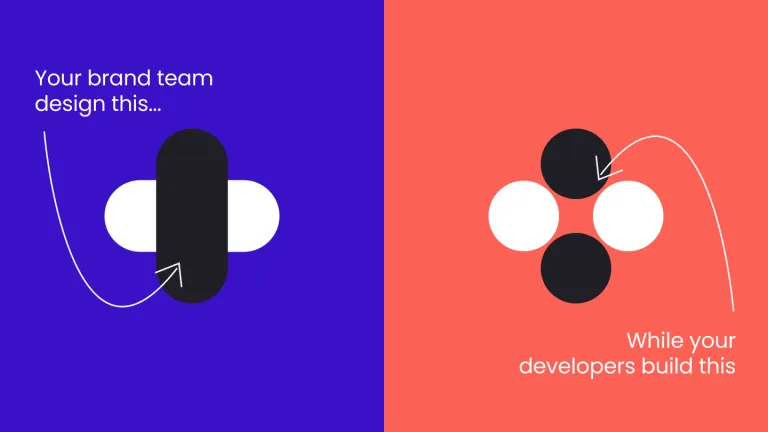
The hidden cost of separated brand and digital work
This isn't anyone's fault. For decades, brands originated in print because that's where they appeared. But today, the vast majority of brand interactions happen on screens—websites, apps, social media, digital communications. Yet many organisations still build their brand identity for print first, then attempt to retrofit it for digital.
The consequences compound quickly. Teams work in silos, each interpreting those print guidelines differently. A simple button gets built seventeen different ways across different properties. That elegant brand typeface? One team uses it at 16px, another at 14px, a third switches to a system font because the brand font performs poorly on mobile. Developers inherit beautiful mockups with no guidance on how things actually work, the interactive states, the responsive behaviour, the accessibility requirements.
We've seen this pattern repeatedly: organisations commission beautiful brand work from one agency, then hand it to a digital team (internal or external) to "make it work online." The digital team inherits assets that weren't designed for screens, colours that fail accessibility tests, typography that doesn't scale, no guidance on interactive states or responsive behaviour. They end up rebuilding the brand system from scratch for digital, just with different constraints. Meanwhile, the organisation returns to the original brand agency for the next refresh, perpetuating an expensive cycle: beautiful brand work that doesn't translate, followed by costly interpretation and rebuilding for every digital property.
This fragmentation creates enormous waste. Designers recreate components that exist elsewhere in slightly different forms. Developers maintain multiple versions of essentially identical elements. Updates require coordinating across disconnected systems. And users experience the inconsistency; buttons that look unfamiliar, navigation that relocates without warning, interactions that behave differently across your digital ecosystem.
The root cause isn't lack of talent. It's separating brand strategy from digital implementation. A brand colour that works on glossy paper might fail accessibility contrast requirements on screen. Typography that's elegant in a brochure might be unreadable on mobile. Layout grids designed for A4 don't translate to responsive interfaces. When different teams handle brand and digital, these disconnects are inevitable.
The stakes have never been higher
We're operating in what economists Joseph Pine and James Gilmore termed the Experience Economy, where experiences have become more valuable than underlying products or services. Customer experience has overtaken both product quality and price as the primary brand differentiator.
The numbers confirm this. Research shows 55% of customers say nothing excuses a bad customer experience, with digital touchpoints often forming that crucial first impression. For organisations earning £1 billion annually, investing in customer experience can yield an additional £700 million within three years. Meanwhile, 81% of business leaders consider digital transformation critical for success.
Yet organisations continue treating digital brand expression as a translation exercise rather than native practice. The result? Fragmented experiences that undermine trust and drive users away—exactly what those statistics warn against.
The digital-first solution
Here's where the thinking needs to shift: what if your brand was built for screens from the ground up?
A digital-first brand system starts with digital constraints and possibilities as its foundation. Rather than creating guidelines for print and adapting them for digital, you build your brand system natively for screens, interactions, and responsive behaviours. When your brand originates in digital, adapting to print becomes straightforward. The reverse journey—print to digital—is where fragmentation creeps in.
What makes this work is building on atomic design principles—creating from small, reusable components that combine into larger patterns. Instead of designing each page from scratch, you create a comprehensive component library: buttons, form fields, navigation patterns, card layouts. Each component is built once, properly, with all its states, accessibility features, and responsive behaviours considered from the start.
These components are defined using design tokens, the fundamental variables of your visual language. Not just "use this shade of blue," but a system specifying colours, typography, spacing, and other properties that work across platforms and update systematically.
But here's what's critical: this requires a team that understands both brand strategy and digital implementation working together from the start. Designers who understand accessibility, responsive behaviour, and component thinking. Developers who appreciate design nuance and brand expression. The siloed approach—where brand strategists create guidelines in isolation, designers create mockups, developers figure out implementation—is where consistency dies and costs multiply.

Why this changes everything
When you build your brand digital-first with integrated expertise, several advantages emerge:
Consistency becomes structural. Your brand expression lives in reusable components. Every button uses the same underlying element, ensuring identical behaviour. Visual consistency isn't maintained through vigilance, it's guaranteed through architecture.
Accessibility is foundational. Colour contrast meets WCAG guidelines by default. Interactive states are part of your brand language from day one. This isn't just good practice, it's often legal requirement and dramatically easier to build in than retrofit.
Efficiency compounds. Build a form field once, with all its states, validation, and accessibility, and deploy it everywhere. Development teams stop rebuilding basics and focus on solving actual user problems. Speed to market accelerates because teams work from the same source of truth.
Quality improves through concentration. Instead of seventeen versions of a button scattered across properties, you have one version receiving concentrated attention and testing. Fix a validation pattern once, and every property benefits. Update colour contrast ratios, and all properties improve simultaneously.
Updates become systematic. Need to adjust colours for accessibility? Update the design tokens and changes flow through every component. Want to refine typography for mobile? One update propagates everywhere. Instead of months coordinating across disconnected systems, changes happen systematically.
Consider GOV.UK's design system, which brought coherence to nearly 30,000 federal websites. This is digital-first thinking at scale: building once, properly, then deploying systematically.
Getting started: the practical path
Building a digital-first brand system doesn't require destroying everything and starting over:
Start with integrated expertise. Assemble a team that understands both brand strategy and digital implementation. This isn't a luxury, it's essential. The separation of brand and digital work is what creates the problems we've described.
Audit honestly. What components exist across your properties? Where do they align and diverge? Which elements need variation versus standardisation? Be honest about what's working versus what you wish was working.
Build foundations first. Focus on building blocks that appear everywhere—colour system, typography, spacing, core interactive elements. These deliver immediate value and establish patterns for everything that follows.
Treat it as a product. Your design system needs ongoing investment and continuous improvement. It's living infrastructure, not a one-time deliverable. Budget for maintenance, plan for evolution, and expect it to grow more valuable over time.
Building for the experience economy
As organisations compete increasingly on experience rather than product features, the infrastructure supporting those experiences becomes strategic advantage. Digital-first brand systems represent that infrastructure—the native architecture enabling consistent, high-quality experiences at scale.
They're not about stifling creativity. Properly implemented, they liberate teams to focus on meaningful innovation rather than reinventing basics. They enable organisations to move faster while maintaining quality. They translate brand strategy into tangible user experience in the environment where it matters most.
The organisations thriving in 2025 and beyond won't be those with the most beautiful PDF brand guidelines. They'll be those that recognise their brand lives primarily on screens and build accordingly—with the right principles, the right components, and crucially, the right integrated team to bring it all together.

About the author
As Zoocha's Senior UI Designer, Dan is passionate about all things design. He loves taking ideas and turning them into results that look good and feel right to use. With a strong eye for detail, he's always thinking about how designs can be refined, simplified, or pushed further. He's always on the lookout for the next best thing in design, whether that’s new trends, tools, and better ways to build design systems.
How can we help?
-
Strengthening Drupal Security: Zoocha’s Contribution to a CVE-Linked OpenID Connect Issue
Zoocha's Kimberley Massey…
-
The Case for LocalGov Drupal: Shared Innovation, Reduced Costs, Better Outcomes
Born out of a collective …
-
AI Search and GA4: Rethinking Website Visibility and Success Metrics
Learn how AI-driven searc…
-
What ISO Certifications Tell You About an Agency (and Why It Matters)
Want to separate marketin…


