Why We Need Agile Delivery More Than Ever


Agile meets AI
AI lowers the cost of building but Agile lowers the cost of building the wrong thing.
Over the past year, a growing number of LinkedIn posts and blog articles have declared loudly that the age of Agile is over.
The argument is usually some variation of the same theme: artificial intelligence can generate code, automate testing, accelerate delivery and reduce the need for large development teams. If software can be produced faster than ever before, surely the processes built around software delivery become less relevant or, worse, redundant?
The problem with this proposition is that it fundamentally misunderstands what Agile frameworks were created to solve.
Being ‘agile’ was never about helping teams write code faster. It was designed to help organisations navigate uncertainty, validate assumptions and continuously learn what creates value for users.
AI changes how software is built; that is a fact. However, it does not remove the need to decide what should be built, why it matters, whether it is safe, whether it meets user needs or whether it will create meaningful outcomes.
At Zoocha, our experience is not that Agile methodologies are made obsolete by AI; instead, they are one of the reasons we can test, learn and adopt AI confidently.
Why people think Agile is becoming obsolete
The rise of generative AI has transformed, and continues to transform, many aspects of software development.
Development teams can generate boilerplate code in seconds. Automated testing capabilities continue to improve. Prototypes can be created rapidly. Documentation can be generated automatically. Manual, repetitive tasks that once required days of effort can now take hours or even minutes to complete.
As a result, some commentators have concluded that Agile methodologies have become a time consuming overhead.
The flaw in this argument is that it assumes the biggest challenge in software development is implementation.
It is not.
The greatest risk in digital product development has rarely been the ability to build something. The greater risk has always been building the wrong thing.
Agile development was never about writing code faster
To understand why Agile methodologies remain relevant, it is worth revisiting its origins.
The Agile Manifesto emerged as a response to traditional, waterfall project approaches that relied heavily on prediction and upfront planning. Projects could deliver against a specification and still fail to create meaningful value.
Agile offered a different approach. Rather than assuming we can accurately predict the future, Agile principles embrace uncertainty. Rather than relying on extensive upfront planning, it prioritises learning through delivery. Rather than measuring success through outputs, it focuses on outcomes.
While the Agile Manifesto and frameworks like Scrum and Kanban have their origins in software development, they are not solely for use in software development environments. Agile frameworks offer a way of managing uncertainty and reducing risk in complex environments.
That challenge has not disappeared because AI exists - if anything, it has become more pronounced.
AI lowers the cost of building, but agility lowers the cost of being wrong
One of the most significant effects of AI is that it reduces the cost and effort required to create software.
This is an important advancement.
However, reducing the cost of implementation does not reduce the cost of poor decisions. This creates a paradox: the easier it becomes to build software, the more important it becomes to validate whether that software should be built in the first place.
This is where organisational agility is worth its weight in gold. Short feedback loops, stakeholder collaboration, incremental delivery and empirical decision-making help organisations identify incorrect assumptions before significant investment occurs.
AI powered tools or workflows may reduce the cost of implementation, but using Agile methodologies to guide them lowers the cost of being wrong. Organisations ultimately need both.

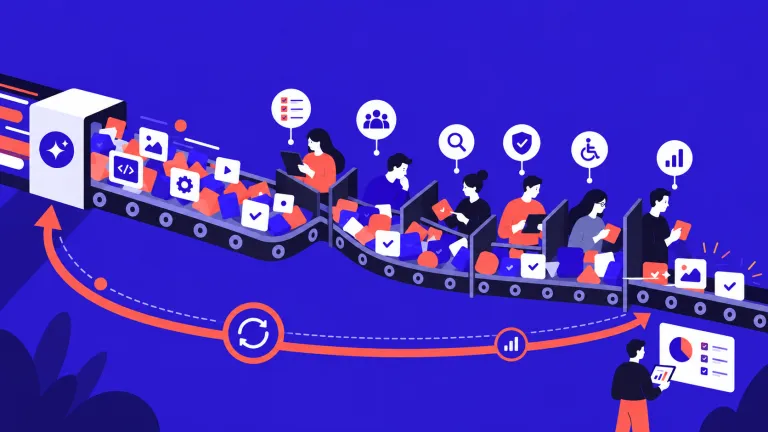
AI moves bottlenecks; it doesn’t remove them
As we’ve outlined thus far, many discussions about AI focus on the acceleration of software development activities. What receives less attention, however, is what happens after development capacity increases.
In any system, improving one stage of the process does not remove constraints altogether, it simply shifts them elsewhere.
For many organisations, AI is enabling teams to generate ideas, prototypes, code and tests faster than ever before. As a result, software development is becoming less of a bottleneck.
The challenge is that the activities surrounding development are not accelerating at the same rate. Development may accelerate, but feedback, prioritisation, governance, accessibility, security and operational decision-making do not necessarily accelerate at the same rate.
The risk is that organisations optimise for delivery speed while creating growing queues elsewhere in the system. Backlogs become larger, decisions become delayed, features accumulate faster than they can be validated, and teams produce more output without increasing learning.
This is where Agile (from our experience, Scrum) ceremonies and behaviours become essential. Scrum ceremonies and feedback loops are often dismissed by some commentators as administrative overhead. In reality, they are mechanisms for converting output into validated learning.
Scrum was never designed to maximise the volume of work produced. It was designed to maximise learning and value delivery by creating regular opportunities for inspection, feedback and adaptation.
As AI increases development capacity, organisations need stronger mechanisms for prioritisation, validation and stakeholder engagement. Otherwise they risk creating a new form of waste: rapidly producing features that have not been reviewed, validated or proven valuable.
The question is no longer only, “How quickly can we build?”. Increasingly, the question is, “How confidently can we decide what is worth building next?”.
The AI era creates more uncertainty, not less
Another assumption behind the "Agile is dead" narrative is that AI somehow makes technology strategy more predictable. In fact, the reality appears to be the opposite.
AI is accelerating change across almost every industry. We can see that customer expectations are evolving rapidly and new tools are emerging weekly. Organisations are experimenting with new products, services and operating models at unprecedented speed. In the background, regulatory frameworks continue to develop.
All of this together ultimately creates an environment characterised by constant uncertainty and this is exactly the set of conditions where Agile thrives.
The more rapidly conditions change, the less effective long-term prediction becomes. Organisations must instead rely on shorter planning horizons, continuous learning and frequent adaptation.
For organisations operating in regulated sectors such as government, healthcare, higher education and financial services, this matters significantly. The challenge is no longer just delivering software quickly; it is ensuring that software remains secure, accessible, compliant and aligned with organisational standards as delivery accelerates. Therefore, the need for transparency, inspection and adaptation becomes even more important. These delivery controls also sit within Zoocha’s wider AI governance framework, helping us assess and manage AI-related risks as tools, regulations and client expectations continue to evolve.
Agile methodologies give AI the structure it needs
This is one of the reasons we believe a mature Agile delivery model puts organisations in a stronger position to adopt AI confidently.
AI-powered tools can increase delivery capacity, but Agile processes provide the structure needed to use that capacity responsibly. Sprint Planning, backlog refinement, review points, Retrospectives and Definition of Done criteria create regular opportunities to inspect work, validate assumptions, manage risk and ensure outputs meet agreed standards.
At Zoocha, this means AI-assisted delivery does not sit outside our established ways of working. It is absorbed into them.
The same principles still apply: work must be prioritised, understood, reviewed, tested and aligned to client outcomes. AI can help accelerate parts of the process, but existing processes ensure that acceleration remains visible, accountable and focused on value.
This is particularly important for clients. AI should not feel like a leap of faith, or like a weakening of delivery control. It should feel like an enhancement to an already disciplined delivery model.
AI gives teams more capability and Agile frameworks help ensure that capability is applied with clarity, control and purpose.

Agile principles are part of how we manage change
The idea that Agile frameworks only exist to manage software delivery misses a bigger point.
At Zoocha, such principles also shape how we manage strategic change and continuous improvement across the business. Our Zoocha Strategic Initiatives and Zoocha Continuous Improvement workstreams give us a structured way to capture ideas, assess priorities, assign ownership and review progress over time.
That experience matters in the context of AI. AI is creating new opportunities quickly, but not every opportunity should become a project, product feature or operational change. Some ideas need further exploration, governance input, testing with clients or, in some cases, should be parked.
Agile practices will evolve; the principles will endure
None of this means Agile practices should stay exactly the same.
AI will change how teams write code, test software, create documentation, analyse defects, generate prototypes and explore technical options. It may change the shape of teams. It may change how quickly ideas can be tested. It may reduce the time required for certain implementation tasks.
Agile delivery needs to evolve in response.
Backlog refinement may become more focused on problem definition, constraints and success criteria. Sprint Reviews/Demos may place even greater emphasis on validation and measurable outcomes. Definition of Done criteria may increasingly need to account for AI-assisted work, including explainability, security, accuracy, appropriate human oversight and any additional controls identified through the organisation’s AI governance processes. Retrospectives may need to explore how AI tools are affecting quality, collaboration and decision-making.
The practices will adapt because the environment is changing.
But the core principles of transparency, inspection and adaptation remain as relevant as ever.
The real risk is confusing AI capability with product understanding
The biggest risk in the AI era is not that organisations will fail to produce enough software. The bigger risk is that they will produce too much of the wrong software, too quickly.
It can support teams, but it cannot replace the hard work of understanding users, making trade-offs, prioritising outcomes and managing risk.
This is where Agile frameworks, product thinking and human judgement continue to matter.
Well-run product backlog refinement and roadmap planning keep asking the questions that AI cannot answer on its own:
- What problem are we solving?
- Who are we solving it for?
- How will we know whether it has worked?
- What risks are we introducing?
- What have we learned?
- What should we do next?
These questions are not less relevant because software is easier to produce; they are more relevant because software is easier to produce.
What this means for clients
For clients, the message is not that AI replaces the need for a clear delivery approach. The message is that AI makes a strong delivery approach even more important.
At Zoocha, our Scrum framework gives clients visibility of what is being worked on, why it has been prioritised and how progress is being inspected. It creates regular opportunities for feedback and sign-off. It supports better management of scope, budget, quality and risk. It helps ensure that acceleration does not come at the expense of control.
AI may help us move faster, explore more options and reduce repetitive effort, but it does not remove the need for clear requirements, accountable ownership, quality gates, testing, review or governance. In practical terms, AI-assisted work is still reviewed, validated and owned by Zoocha team members, and must meet the same quality, testing, security and delivery expectations as work produced without AI.
This is also supported by our wider AI governance work. Zoocha has now achieved ISO/IEC 42001:2023 certification for our Artificial Intelligence Management System, providing independent assurance that our use of AI is governed through a structured framework for accountability, risk management, transparency and continual improvement. This complements our Agile delivery model: AI-enabled work can move quickly, while remaining subject to clear human ownership, regular review and appropriate controls.
Conclusion
AI is changing how software is delivered, but it does not remove the need for product judgement, governance, quality assurance or client collaboration.
If anything, it makes those disciplines more important.
The organisations that benefit most from AI will not be the ones that simply produce more output. They will be the ones that combine faster delivery with stronger prioritisation, better feedback loops and appropriate guardrails.
At Zoocha, our experience is that Agile does not hinder AI-enabled delivery. It gives us the structure to use AI with confidence, accountability and clear focus on client value.

About the author
As Operations Director, Hannah ensures standards of quality, accountability and Agile principles are at the heart of each project delivered by the expansive global team. From mentoring junior Scrum Masters to facilitating the adoption of Agile in large scale public sector institutions, Hannah takes a person-centred approach to opening the doors to Agile and embracing the flexibility of the Scrum Framework.
How can we help?
-
Responsive Design Beyond Breakpoints: Just Because It Scales Doesn’t Mean It Works
Responsive design should …
-
Creating reusable components without bloating your design system
Reduce design system bloa…
-
User Research Isn't a Luxury. It's How You Get the Results You Need.
User research isn't a lux…
-
Digital Degradation: What it is and How to Prevent it
A UX audit reveals the sm…


