Drupal Dev Days Athens 2026: AI, Architecture, and the Future of Drupal


Drupal Dev Days Athens 2026 brought together developers, architects, agencies, and maintainers from across the Drupal ecosystem to discuss the future of the platform. While topics ranged from performance and content architecture through to developer experience and governance, AI emerged as one of the defining themes throughout the event as something that is actively being integrated into Drupal workflows, tooling, and architecture right now.
What stood out throughout the conference was how far the conversation had moved beyond theory. Alongside genuinely exciting examples of AI improving Drupal delivery and content management, there were also important discussions around implementing AI thoughtfully, the impact on developers, and the wider consequences for the open web.
AI that solves real issues
A standout session was "Stop Mapping Fields by Hand: Automating Drupal Migrations with AI + Migrate API". Content migration is often one of the messiest and most time-consuming parts of any Drupal project, especially when dealing with inconsistent legacy data and poorly structured content. The session showed how AI-assisted mapping and migration tooling can help reduce some of that manual effort, taking some of the pain out of untangling large migrations while still keeping developers in control of the process.
Similarly, "Beyond Chunk and Pray: Smarter RAG for Drupal AI" explored how AI-powered retrieval systems can move beyond simplistic implementations and become genuinely useful when paired with structured content and smarter retrieval strategies. It reinforced a recurring theme across the event: Drupal’s structured approach to content gives it a strong foundation for building more reliable AI experiences.
There was also a lot of excitement around orchestration and workflow tooling. "FlowDrop: Rethinking Workflow and Orchestration in Modern Drupal" showcased a slick approach to managing increasingly complex digital workflows and integrations. As Drupal platforms become more connected to external services, AI systems, APIs, and automation layers, tools like this feel increasingly important.
Other sessions demonstrated the growing breadth of AI use cases within Drupal; "Drupal CMS AI - No-code Visual AI Agent Builder - Future of Agents" highlighted how AI agents are becoming configurable platform features rather than purely developer-built systems. "Hybrid Semantic Search in Elasticsearch: Combining Meaning with Medical Rules" showed how semantic search and structured business rules can work together in regulated environments.
"Taming complex Drupal projects with AI-assisted specification and codebase analysis" demonstrated how AI can help developers navigate large, complicated codebases more efficiently, while "Turning AI Agents configuration into clear and maintainable AI Workflows" focused on making AI systems understandable and maintainable over time, something many organisations are only beginning to think about.
Taken together, the talks highlighted how rapidly these capabilities are maturing within the Drupal ecosystem. AI is no longer just a chatbot bolted onto a website, it is increasingly being used to improve migrations, search, workflows, project analysis, orchestration, and content operations across the Drupal ecosystem.
A broader conversation around AI innovation
Alongside the technical implementations, several talks explored the wider impact of AI as the technology continues to evolve.
The keynote "We need to talk about AI" focused on the wider ethical and societal implications of AI, particularly within open-source communities. The discussion pushed beyond hype and asked harder questions around responsibility, sustainability, and who ultimately benefits from these systems.
Similarly, “A future without juniors” explored the concern that AI-assisted development could fundamentally change how new developers learn and enter the industry. If AI increasingly handles repetitive tasks and scaffolding work, what happens to the learning pathways that junior developers traditionally rely on?
Another important perspective came from "Stop the Stampede: Scaling and Defending Drupal in the Age of AI Scrapers", which highlighted the growing operational impact AI companies are already having on websites through aggressive scraping and infrastructure strain. It was a reminder that AI is not only changing development workflows, it is also actively reshaping the web itself.
Even the keynote "Emotional Intelligence and AI: The Psychology of Coding" added a more human perspective to the discussion, exploring how AI changes the way developers think, create, and interact with technology.
Drupal beyond AI
In addition to the AI-focused sessions, several talks reinforced the importance of Drupal’s traditional strengths.
"Bursting the Bubble: Why Code Alone Won’t Save the Open Web" highlighted the need for openness, accessibility, and sustainable digital ecosystems beyond pure technical innovation.
"Stability & Innovation: Web Acceleration with Drupal Core and Drupal CMS" focused on performance, scalability, and platform maturity. These are still critical priorities for enterprise Drupal projects.
Content architecture and migration strategy continued to be major areas of focus; "Migrating messy content to Drupal" tackled the realities of legacy content migrations and the importance of preparation and governance.
"Same Image, Different Story: Why Drupal Needs Contextual Architecture" reinforced how content meaning changes depending on audience and delivery context, something becoming even more important in AI-driven experiences.
For developers, several sessions focused on improving the day-to-day development experience, exploring practical ways to automate routine maintenance, standardise local development environments, and reduce the operational overhead of managing Drupal projects at scale:
"Automatic update routines for smaller and larger Drupal projects" Keeping Drupal platforms secure and up to date has always been one of the ongoing operational challenges for teams managing multiple environments and large codebases. The session explored how automated update routines can help streamline that process, reducing repetitive maintenance work while still allowing teams to maintain appropriate testing and deployment controls.
"From Chaos to Consistency: One Custom DDEV Add-on for Optimising Developer Experience Across 110+ Projects" This session focused on solving a common challenge for development teams: maintaining consistent local environments and onboarding processes across multiple developers and projects. Using a custom DDEV add-on, the talk demonstrated how teams can reduce environment drift, simplify setup, and standardise local tooling without adding unnecessary complexity to day-to-day development.
Beyond checkout: Drupal commerce beyond commerce
I also presented a session titled "Beyond Checkout: Using Drupal Commerce to Power a Custom Accounts Management System".
The talk explored how Drupal Commerce can be used beyond traditional e-commerce implementations, leveraging Commerce entities and workflows to support more complex account management and operational systems.
A conference built around community
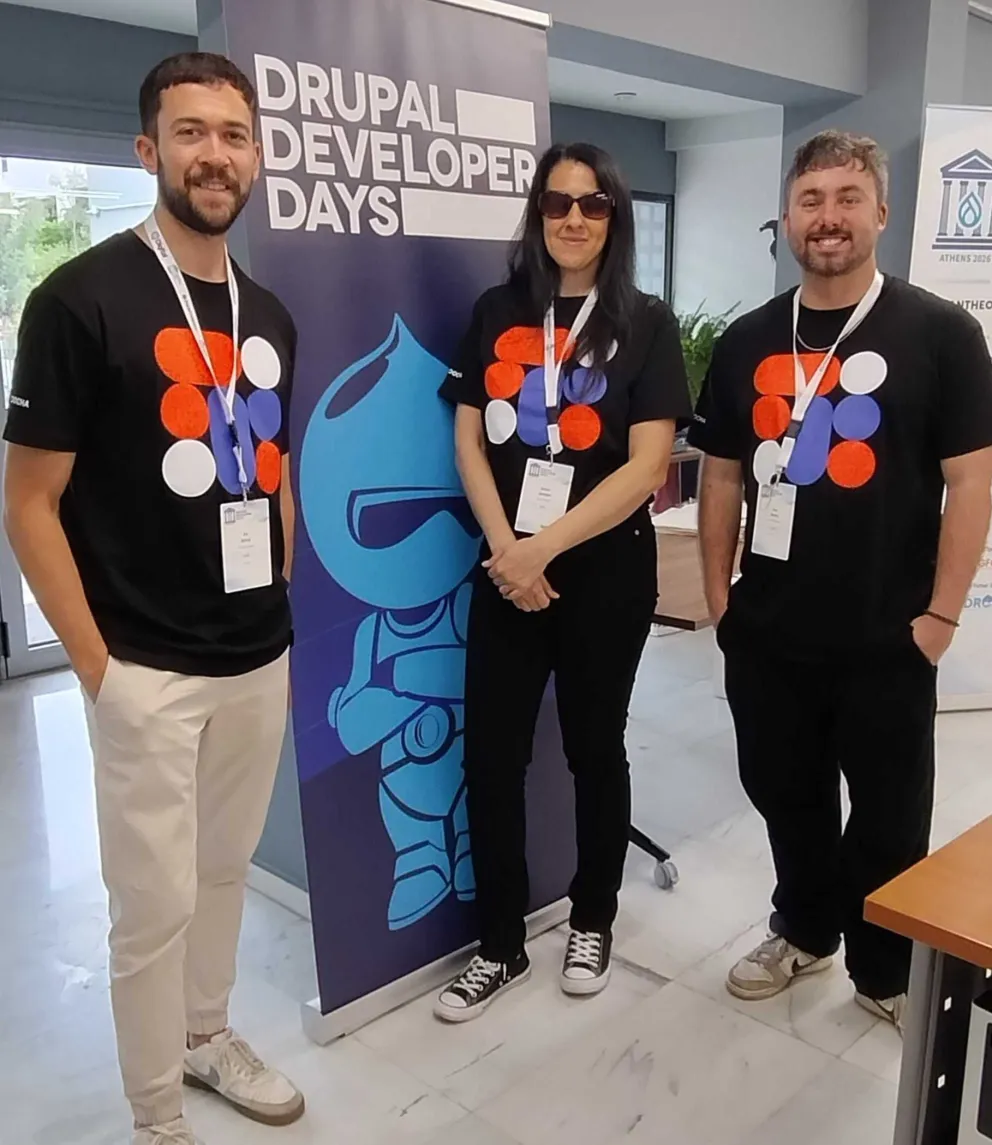
Beyond the sessions themselves, one of the nicest surprises was simply the scale and atmosphere of Drupal Dev Days. As our first Drupal Dev Days event, we were not entirely sure what to expect, but the turnout was far bigger than anticipated, with a strong mix of developers, architects, maintainers, and agencies from across the Drupal community.
What stood out throughout the event was how approachable and collaborative the community felt. Conversations flowed naturally between sessions, over coffee, and during the evening social events, with people openly sharing ideas, challenges, and experiences from real-world Drupal projects. Despite the increasing focus on AI and automation, the conference still felt deeply people-focused.
Athens also proved to be an excellent host city. The venues, social events, and overall organisation created a relaxed atmosphere that made networking easy, and the food certainly lived up to expectations.
The bigger takeaway
One of the clearest themes throughout Drupal Dev Days Athens 2026 was how quickly AI is moving from experimentation into practical implementation across the Drupal ecosystem. Sessions explored how AI can improve migrations, search, workflows, developer tooling, and content operations, with much of the discussion focused on how to integrate these capabilities effectively into real-world platforms and delivery processes.
At the same time, the conference recognised the importance of approaching AI responsibly. Topics such as developer learning pathways, AI-driven scraping, and the need for maintainable, well-governed systems highlighted the growing focus on long-term sustainability and oversight. Alongside the AI discussions, the event also reinforced that Drupal’s long-standing strengths, structured content, strong architecture, scalability, and openness, remain central to its future.
Overall, Drupal Dev Days Athens 2026 showed a community embracing AI innovation while remaining focused on practical, scalable, and sustainable implementation.

About the author
Denise Spangler is a Back End Principal Drupal Developer who loves solving puzzles, whether that's writing code, analysing data or researching the best technical approach to a problem. As an Acquia Certified Drupal Developer, she specialises in Drupal, PHP and MySQL, with a keen eye for detail and a highly analytical mindset. When she's not working on web projects, you'll likely find her practising Taekwondo, where she's earned a black belt!
How can we help?
-
Double WebAward win for Zoocha: two Outstanding Websites in 2026
Zoocha is celebrating a d…
-
Zoocha Reach Top Tier Drupal Partner Status
Zoocha joins the world’s …
-
Zoocha achieves ISO/IEC 42001 certification for responsible AI management
Discover how our integrat…
-
Zoocha Earns Living Wage Employer Accreditation
Recognising our commitmen…


